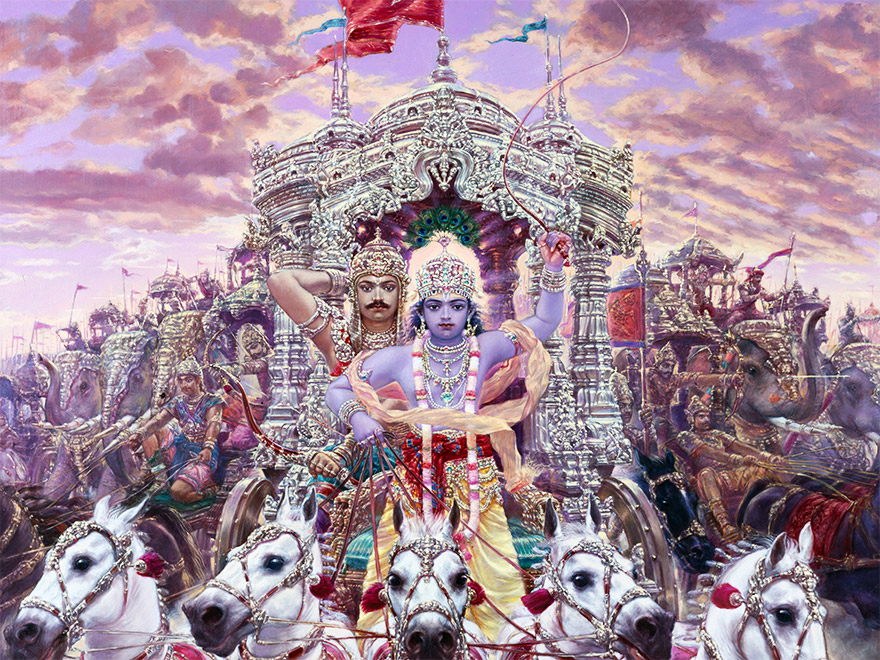
The Bhagavad-gita opens with blind King Dhritarashtra requesting his secretary, Sanjaya, to narrate the battle between his sons, the Kauravas, and their cousins, the Pandavas. Lord Krishna, the Supreme Personality of Godhead, out of affection for His devotee, the Pandava prince Arjuna, has agreed to drive his chariot. As Arjuna takes up his bow and prepares to fight, he sees the sons of Dhritarashtra drawn in military array and requests infallible Krishna to draw his chariot between the two fighting forces. There in the midst of both armies, Arjuna’s mind reels as he foresees the imminent death of his teacher, relatives, and friends. He throws down his bow and arrows and decides not to fight.
In Chapter One and in the beginning of Chapter Two, Arjuna presents his arguments for refusing to fight. Basically, he fears the sinful reactions of killing. But after Arjuna surrenders to Lord Krishna and requests the Lord to instruct him, the Lord begins countering Arjuna’s objections. First, Krishna analytically explains that fighting in His service is transcendental and will bring no sinful reaction. Krishna also explains the Vedas’ purpose as to gradually elevate souls to Krishna consciousness. Krishna thus encourages Arjuna to remain fixed in His service – fight – and ignore his mind’s desires.
As Krishna’s explanations why Arjuna should fight were only a summary, and since Krishna glorifies both ‘buddhi-yoga’, intelligence used in spiritual advancement of knowledge (2.45, 2.49-50), and ‘karma’, work (2.47-48, 2.50), Arjuna becomes confused and wishes to use Krishna’s instruction to perform ‘buddhi-yoga’ as an excuse to retire the battlefield for a life of contemplation. Arjuna therefore opens Chapter Three asking Krishna why He is encouraging fighting if intelligence is better than fruitive work.
Krishna then explains ‘karma-yoga’, reaction-free devotional work, and clears up Arjuna’s mistaken idea that all work is fruitive and leads to bondage. Krishna explains that Arjuna should fight, for avoiding sinful reactions though devotional work is better than attempting to escape reactions though renouncing work. Krishna also instructs Arjuna to fight to set the proper example of duty. Krishna therefore tells Arjuna to fight, but with knowledge and detachment (3.29-30), without falling victim to his own attractions and aversions.
Then, in answer to Arjuna’s question on the cause of a soul’s being impelled to improper action or neglect of duty, Krishna names the enemy: lust. He then recommends Arjuna to regulate his senses, become fixed in his pure identity as a servant of Krishna, and thereby avoid lust’s control. Then, with spiritual strength and deliberate intelligence, he should conquer that forceful enemy – lust.
Since in Chapter Three, Krishna has recommended that Arjuna fight in full knowledge of Him (3.30), the Lord, in Chapter Four, explain different aspects of transcendental knowledge. First Krishna explains attaining knowledge through the disciplic succession. Then after successively explaining Hi appearance and then His mission, the Lord explains His devotional service as the goal of (Krishna had already referred to the importance of performing ‘yajna’, sacrifice, in 3.9 Krishna next explains the soul’s relationship with Him as eternal His part and parcel, which one must approach a bonafide spiritual master to learn. Chapter Four ends with Krishna glorifying transcendental knowledge and requesting Arjuna to arm himself with this knowledge – which burns all sinfull reactions to ashes – and fight!
After Arjuna has been impressed with the importance of both work (which requires activity) and seeking knowledge (which tends to be inactive), Arjuna is perplexed. His determination is confused, and he sees fighting and knowledge as contradic Therefore Arjuna opens Chapter Five by asking Krishna to definitivelly explain whether the renunciation of work (speculation, ‘sankhya, jnana’, inaction-in-knowledge) or work in devotion is superior. Krishna answers that one who is detached from his work’s results is the one who is truly renounced. Such a person knows that while the body acts, he, the soul, actually does nothing. Arjuna should therefore, do his duty steadily act for the satisfaction of Krishna. Impartially viewing the external world, he should reside in his body aloof from bodily activities. By fixing his consciousness on the Supreme and knowing that Krishna is the true enjoyer, the goal of sacrifice and austerity, and the Lord of all planets, he, the pure soul, will find true peace beyond this material world.
In the first five chapters, Krishna has explained ‘buddhi-yoga’, working with consciousness focused on Krishna without fruitive desires. The Lord has also explained ‘sankhya’, ‘karma-yoga’,and ‘jnana-yoga’ to obtain liberation and as steppingstones to Krishna consciousness. Now, at the end of the Fifth Chapter (5. 27-28) and continuing on to the Sixth Chapter (wherein Krishna explains practical points for a practicioner), Krishna explains ‘dhyana- yoga’ concluding that ‘dhyana’, or meditation upon Krishna, is meditation’s final goal.
Krishna begins the Sixth Chapter by explaining that the neophyte yogi engages in fruitive sitting postures while the advanced yogi, the true ‘sannyasi’, works without attachment. Such a yogi liberates, not degrades, himself by his mind’s activities. Carefully controlling his mind and engaging it body, and his self in Krishna’s service, the yogi strictly practices ‘dhyana- yoga’ in a secluded place. Fixing his mind on the self and on Krishna, he attains transcendental happiness in the kingdom of God. Arjuna then points out the main difficulty in practicing yoga is controlling the mind. Krishna responds by saying that one can overcome the obstinate mind through constant practice and determination. In responding to Arjuna’s about the fate of an unsuccessful yogi, Krishna answers that one unsuccessful in his practice will still take birth in a family of wise transcendentalists and automatically become attract yogic principles. Krishna finally states in the last two verses of the chapter that the yogi is greater than the ascetic, the jnani and the karmi. And the greatest of all yogis is he who always thinks of Krishna and with grest faith worships Him in loving service.
Knowing Krishna’s instruction at the end of Chapter Six, one should initiate his practice of yoga from the point of concentrating of the mind upon Krishna. Chapter Seven thus opens with Krishna explaining knowledge of Himself and His opulent energies. Thus Arjuna can fully worship Krishna, as described at the end of Chapter Six, and think of Him with devotion as he fights.
Krishna first explains that as He is the Supreme Truth, everything in existence is a combination of His material and spiritual energies. He is the active principle within all and is all- pervasive through His diverse material and spiritual energies. Because the world’s activities are conducted by the three modes of nature which emanate from Him, (Although Krishna is independent and above them) only those who surrender to Krishna can cross beyond these modes to know Him. Four kinds of impious souls never surrender to Krishna while four kinds of pious souls do surrender. Krishna also covers Himself from the impersonalists, who are less intelligent, and from those who surrender to the demigods. But those who are truly pious, the undeluded, serve Krishna as the governor of the material manifestation, the demigods, and sacrifice, can know and understand Krishna – ev the time of death.
Chapter Eight begins by Arjuna asking Krishna about Brahmam, karma, the demigods, the material world, and knowing Krishna at the time of death. Krishna first briefly answers Arjuna’s first five questions and then begins explaining in detail how to know Krishna at the time of death. Since one attains what one remembers at the time of death, if one remembers Krishna, one goes to Him. Krishna then explains how He can be constantly thought of as the transcendental person who knows everything, the oldest controller, the smallest, the maintainer. Thus by pract yoga and remembering Krishna, Krishna explains, one will go to the eternal spiritual world and never again to return to this temporary, miserable material world. Then, after describing the different yogic ways in which one may leave this world, Krishna advises Arjuna not worry about other paths – either Vedic study, yoga, austere sacrifices, charity, jnana, or karma – for the results of these will all be obtained through performing devotional service. And in the end, such a yogi in devotion, reaches the supreme eternal abode.
After Krishna answered Arjuna’s questions in Chapter Eight, He continues speaking, in Chapter Nine, the knowledge about Himself that He had begun explaining in Chapter Seven. Krishna thus prefaces Chapter Nine by stating that the knowledge He’ll now reveal is most confidential, for it is about His actual position, which only the non-envious and faithful can understand. Krishna continues explaining that although independent and aloof, He pervades, creates and anihilates the entire cosmos through His material energy. Those mahatmas who know Krishna as the Supreme Personality of Godhead take shelter of Him and serve Him as the only enjoyer and the supreme object of worship.
Krishna then explains the fortunate position of such devotees: If one worships Krishna, Krishna cares, compensates for his deficiencies, and preserves his strengths. And all Krishna asks for is an offering of a leaf, a flower, or some water – if it is offered with devotion. Thus His devotee comes to Him. Even if a devotee unintentionally commits a horrendous act, he will be rectified, for Krishna promises that His devotee will never perish.
In Chapters Seven and Nine, Krishna has explained knowledge of His energies. In Chapter Ten, Krishna explains His opulences more specifically and thereby reveals Himself the Supreme Personality of Godhead, the source of all. Krishna also tells how His pure devotees know that He is the unborn Supreme Lord, the source of all sages, the source of the material and spiritual worlds, and the source of all qualities and attitudes. Thus pure and wise devotees worship Krishna, converse about Him, and with thoughts dwelling in Him, undeluded and free from sin, engage in His service. Out of compassion, Krishna within their hearts destroys any remaining ignorance.
After hearing of Krishna’s opulences, Arjuna confirms Krishna as the Supreme Lord by quoting authorities and explains that only Krishna can truly know Himself. Krishna then tells of His divine manifestations within this world – as the Supersoul, the ocean, the Himalayas – which merely indicate His limitless opulences, for a single fragment of Krishna’s energy pervades and supports this entire universe!
Arjuna, although acknowledging that Krishna in the two-armed form that he now sees before him is Supreme, still requests Krishna to reveal that all-pervading Universal Form that supports the Universe. Thus, in Chapter Eleven, Krishna proves Himself as the Supreme Lord and He establishes the criteria that anyone who claims to be God must also show a Universal Form. Krishna then reveals to Arjuna His wondrous effulgent, all-expansive form, and Arjuna sees all soldiers on both sides dying within it. Krishna explains His form as time, the destroyer of all world, and requests that Arjuna, knowing in advance the inevitable d of all the warriors, become His instrument. In answer to Arjuna’s fearful prayers, Krishna first shows His four-armed form before again returning to His original two-armed form. Krishna then states that his two-armed form can only be seen by pure devotees, and such pure devotees, working for Krishna, free from desiring fruitive activities, and who make Krishna the su goal of their lives, certainly come to Him.
In Chapter Twelve, Arjuna, after witnessing Krishna’s awesome Universal Form, wishes to clarify his own position as a devotee, the highest worshiper of the Supreme. He thus asks whether worshiping Krishna through devotional service or worshiping the impersonal is superior. Krishna immediatly responds saying that one engaged in His personal service is the topmost. One should therefore engage in Krishna’s service and fix his mind solely upon Krishna, and, if that cannot be done, one should follow the rules and regulations of ‘bhakti-yoga’, which purify one so he is later able to do so. Krishna then describes other processes that eventually lead to His pure devotional service.
Then qualities that endear a devotee to Krishna, which Krishna next mentions, such as equality in both happiness and distress, independence from the ordinary course of activities, satisfaction, and the faithful following of the path of devotional service, are also part of the process of worshiping Krishna in devotional service.
Arjuna opens Chapter Thirteen by inquiring about the field of activities and the knower of that field. Krishna answers that the conditioned soul’s body and that body’s interactions within the material world are His limited field of activities. By understanding the difference between the body, the soul, and the Supersoul and by following the process of knowledge, the soul can transcend the good and the bad he meets, realize his eternal subordination to Krishna, and attain the supreme destination.
The Thirteenth Chapter clearly explained that by humbly developing knowledge one can become free from material entanglement. It is also explained that the living entity’s entanglement within the material world due to his association with the modes of material nature (13. 20-22). Now, in Chapter Fourteen, the Supreme Personality of Godhead, in detail, explains the three modes – goodness, passion and ignorance – those forces that bind and control all conditioned souls within this world. A soul can, however, transcend these modes through devotional service (All other processes are contaminated by the modes). Thus the limitations imposed by his field of activities can be overthrown and the soul can be elevated to the Brahman platform, the constitutional position of purity and happiness – a platform of which Krishna is the basis.
As one must be detached from the modes and their results in order to be attached to the service of the Lord, Krishna describes in Chapter Fifteen the process of freeing oneself from matter’s grip. He begins by comparing the material world to a gigantic, upside-down banyan tree, invoking Arjuna to detach himself from it through surrender. Thus, the soul can end his transmigrations and return to Him in the spiritual world.
Although the foolish cannot understand that the soul transmigrates, quitting one body to obtain a new body based on his mind’s desires, transcendentalists see this clearly. The foolish can learn to see properly by understanding that it is Krishna who is the splendor of the sun, moon, and fire, as the one keeping the planets in orbit and making vegetables succulent. They can see Krishna as the fire of digestion; as the Paramatma in everyone’s heart; as the giver of remembrance, knowledge, and forgetfulness; and as the goal of the Vedas and the compiler of Vedanta. Krishna then reveals that knowing Him as the Supreme Personality of Godhead and engaging in His service is the ultimate purpose of the Vedanta and the most confidential part of the Vedas.
In Chapter Fifteen, auspicious, elevating activities were described as part of the banyan tree. In Chapter Sixteen, after mentioning twenty-six godly qualities, Krishna explains the demoniac nature which degrades the soul through arrogant, ignorant, and conceited pursuits of sense gratification and power.
Krishna explains the demonic mentality as follows: The world is unreal and is produced only of sex desire. Taking shelter of lust, they think of sense gratification as the goal of life and scheme to illegally increase their wealth. While plotting to kill their ‘competitor’ enemies, they think themselves powerful and happy, and they, surrounded by their relatives, use sacrifices and charity only to further increase their happiness. Perplexed by illusory anxieties, bewildered by self-complacency, impudency, and wealth; and envying the Supersoul within their own bodies and within the bodies of others, demons blaspheme real religion. These mischievous, lowest amongst men are repeatedly cast by Krishna into demonic species to gradually sink to the most abominable forms of existence.
Krishna ends the chapter by explaining that because lust, anger and greed are the beginnings of demonic life, all sane men should therefore give them up and understand their duty through faithfully following the scriptures.
Krishna has concluded Chapter Sixteen by declaring that the ultimate difference between the divine and the demoniac is that the divine follow the scriptures while the demons do not. In the beginning of Chapter Seventeen, Arjuna inquires more about those who don’t follow scriptures, but who worship according to their imaginations. Krishna answers by describing how the combination of the modes of material nature that control a particular person will dictate a person’s faith, worship, eating, sacrifices, charity and austerity. The chapter ends with Krishna explaining the syllables ‘om tat sat’ and how these syllables indicate that any sacrifice, austerity, or charity dictated by the modes and performed without devotional service is useless in this lif the next. One should therefore directly take to Krishna’s service in Krishna consciousnes.
The entire Bhagavad-gita is concluded in seventeen chapters, and in the Eighteen Chapter, Krishna reviews the knowledge already presented. In this chapter Krishna concludes, as He has done througout the Bhagavad-gita, that one should practice devotional service – Krishna conciousness.
Since Arjuna’s basic desire to renounce his duty of fighting was fear of sinful reaction, Krishna explains true renunciation and how to transcend sinful reactions through (1) becoming renounced from the fruits of activities,(2) abiding by the order of the Supersoul, and (3) worshiping the Lord through one’s fruits of work by acting either as ‘brahmana’,’ksatryia’,’vaisya’, or ‘sudra’ according to one’s mode of nature. (Each leads Arjuna to fight) Thus, one can achieve the self-realized position of ‘brahma-bhuta’ and that position, detached from all material things, one can practice pure devotional service.
Krishna can only be known through surrendering to Him in devotional service, and by this direct process – free from karma or jnana, Arjuna should need not fear any sinful reactions. Under Krishna’s protection, such a pure devotee will reach “Krishna-loka”. Krishna instructs Arjuna that he should surrender to the Supreme Lord within his heart and thus attain peace in His supreme, eternal abode. The most confidential knowledge is then explained by Krishna: “Become My devotee, always think of Me, act for Me, worship Me, and offer all homage unto Me. Surrender unto Me alone. Do not fear sinful reactions.”
After hearing the instructions of Sri Krishna, Arjuna is fixed and ready to fight. Sanjaya, after narrating this conversation to Dhritarashtra, ecstatically thinks of the wondrous two-armed form of Krishna and predicts victory for Arjuna, the supreme archer, for he is surrendered to Krishna, the master of all mystics.


This is rslision of Hindu.
I have in urgently need of GITA saar in bengali language.
hindu religion is incourage the world for peace and pure
Good Afternoon sir,My name is sapan bandari,studying B.tech first year,sir i want to learn and understanding that how Bhagavad gita,can you teach me that i can prove my self
this is very amazing knowlege
Hello
Could you tell me who has compiled all these articles, summaries, Chapter Mahatmaya etc on the Bhagavad Gita?
Is this a follower of Srila Prabhpada?
Thank you
i want to practice it in my life can any one suggest how to make it live
This is a very helpful and concise summary.
This is a remarkable essay. It was completely thorough and held my attention. It clarified several issues for me. Kudos to the author.
You can get Bhagvad Geeta from any Book Shop or can visit to Local Iskcon Temple and can attend daily free classes on Bhagvad Geeta
This is very helpful as I try to teach the Gita in an Eastern Philosophy class.
Namasteh & hare krsna to you.
kindly let me know as whether krnsa discusses & explains about types of sins or paapa in bhagawat gita. kindly quota the chapter & verse number for my clarication. appreciate your reply. thank you. Hare krsna
The Bhagavad Gita forms a section of the sixth book of the Mahabharata, an important Sanskrit epic in the Hindu tradition that recounts a lengthy struggle and brief war between two sides of the Bharata family—the Pandavas and the Kauravas—over their kingdom of Hastinapura.
In the Gita, a Pandava brother Arjuna loses his will to fight and has a discussion with his charioteer Krishna , about duty, action, and renunciation. The Gita has three major themes: knowledge, action, and love.
Thank you bhagavatgita.us your summary is uniques and well explained. Must appreaciate.
Thank u so much for this summary .it helps a lot in my exam
i’m really elated to read and learn a lot about the lofty ideals of the Bhagavad Gita in a nut shell. it’s really encouraging & a guiding principle to follow for freedom from bondage of life taking birth and death infinitely. we must follow the eternal path enshrined by lord Krishna in the last chapter of the Bhagvad Gita where we are advised by Him to become His devotee, always think of Him, act for Him and offer all homage unto Him.He also called for complete surrender unto Him alone. Finally, He forbids us to fear sinful reactions.
Thank you for posting this Gita Summary! This is very helpful in understanding the essence of Gita, truly the best literature of this world!
Jai Shri Krishna this Gita summary so much helpful .